
Between KIT and Karlsruhe: KITspark at the heart of closer collaboration
To make cities more resilient and sustainable in times of crisis, academia, government, and society must cooperate even more closely. This is precisely what the Karlsruhe Institute of Technology (KIT) and the City of Karlsruhe have set out to do. In early May, KIT President Professor Jan S. Hesthaven and Karlsruhe Mayor Dr. Frank Mentrup signed a memorandum of understanding (MoU) to that effect.
Key elements of the planned collaboration include the implementation of joint real-world laboratories in urban areas, the creation of new formats for exchange, and the integration of urban challenges into practice-oriented teaching and learning formats. Both sides also aim to promote the exchange of data, for example, to support evidence-based decision-making at the local level.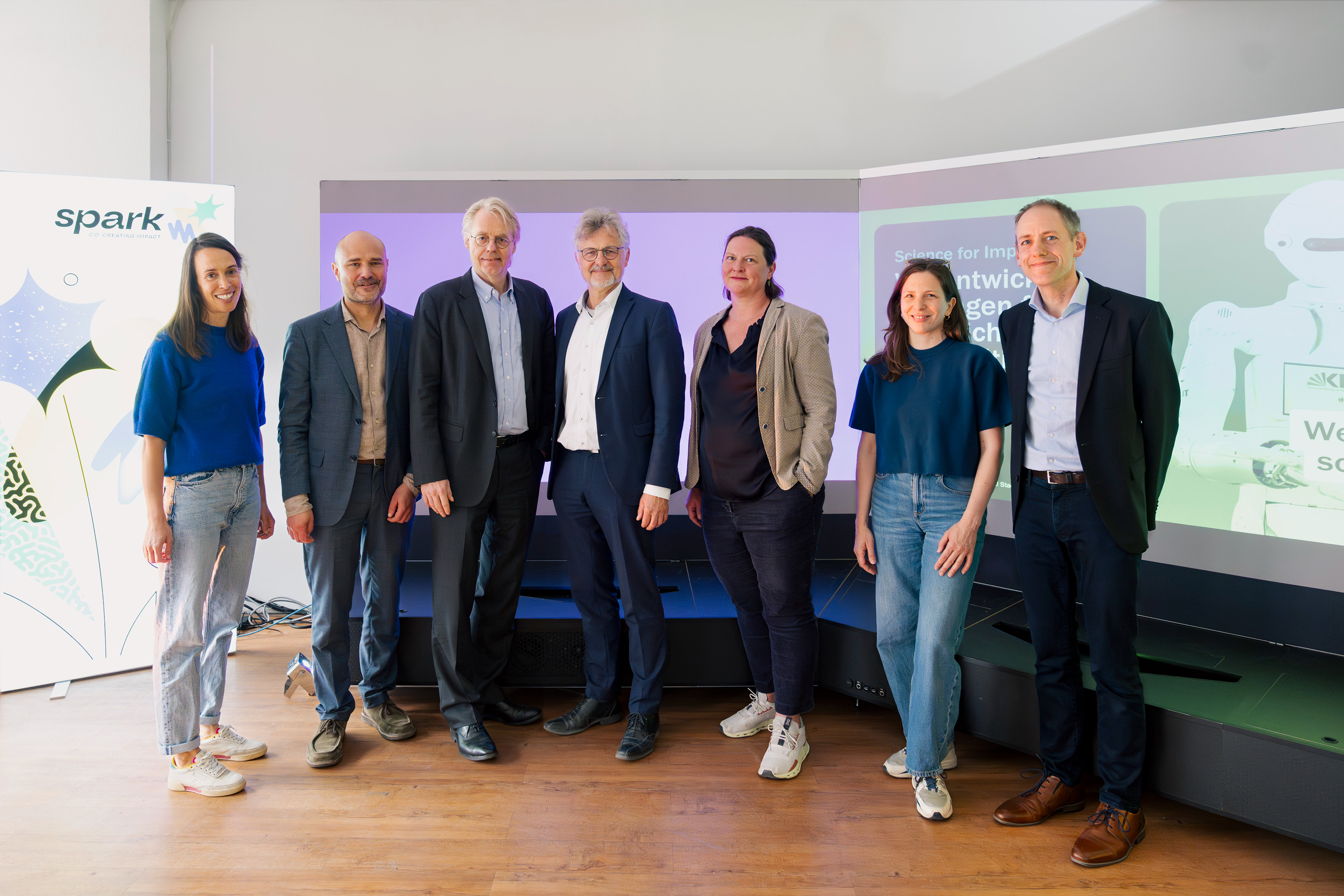
They plan to use KIT spark for joint projects: Leonie Hensgen and Daniel Lang (ITAS), Jan S. Hesthaven, Frank Mentrup, Sandra Mähliß, and Oriana Kraemer (City of Karlsruhe), as well as Jan Cermak (KIT Institute for Meteorology and Climate Research).
New infrastructure for transdisciplinary projects
The signing of the MoU took place at the new KIT spark facility, located not far from Karlsruhe’s Kronenplatz—a joint initiative of KIT’s Institute for Technology Assessment and Systems Analysis (ITAS) and Institute for Information Systems (WIN), as well as the KIT-Center Humans and Technology. Starting in the summer of 2026, researchers and non-academic stakeholders will be able to collaborate there on transdisciplinary projects—ranging from modeling and citizen science projects to real-world experiments—aimed at building the resilient city of tomorrow. On the occasion of the signing of the MoU, spark co-initiator Daniel Lang from ITAS presented how these joint activities are integrated into the Helmholtz Association’s program-oriented research.